





For decades, the factory floor changed slowly: a new line here, a new robot there, and long planning cycles in between. In 2026, that pace is clearly quickening. Across the United States and other major manufacturing regions, factories are adopting AI systems that watch production in real time, predict problems before they stop a line, and adjust workflows with far less manual intervention. What began as isolated pilot projects is becoming one of the defining industrial trends of the year — a shift toward smart automation that blends machines, sensors, and human expertise.
What’s Changing
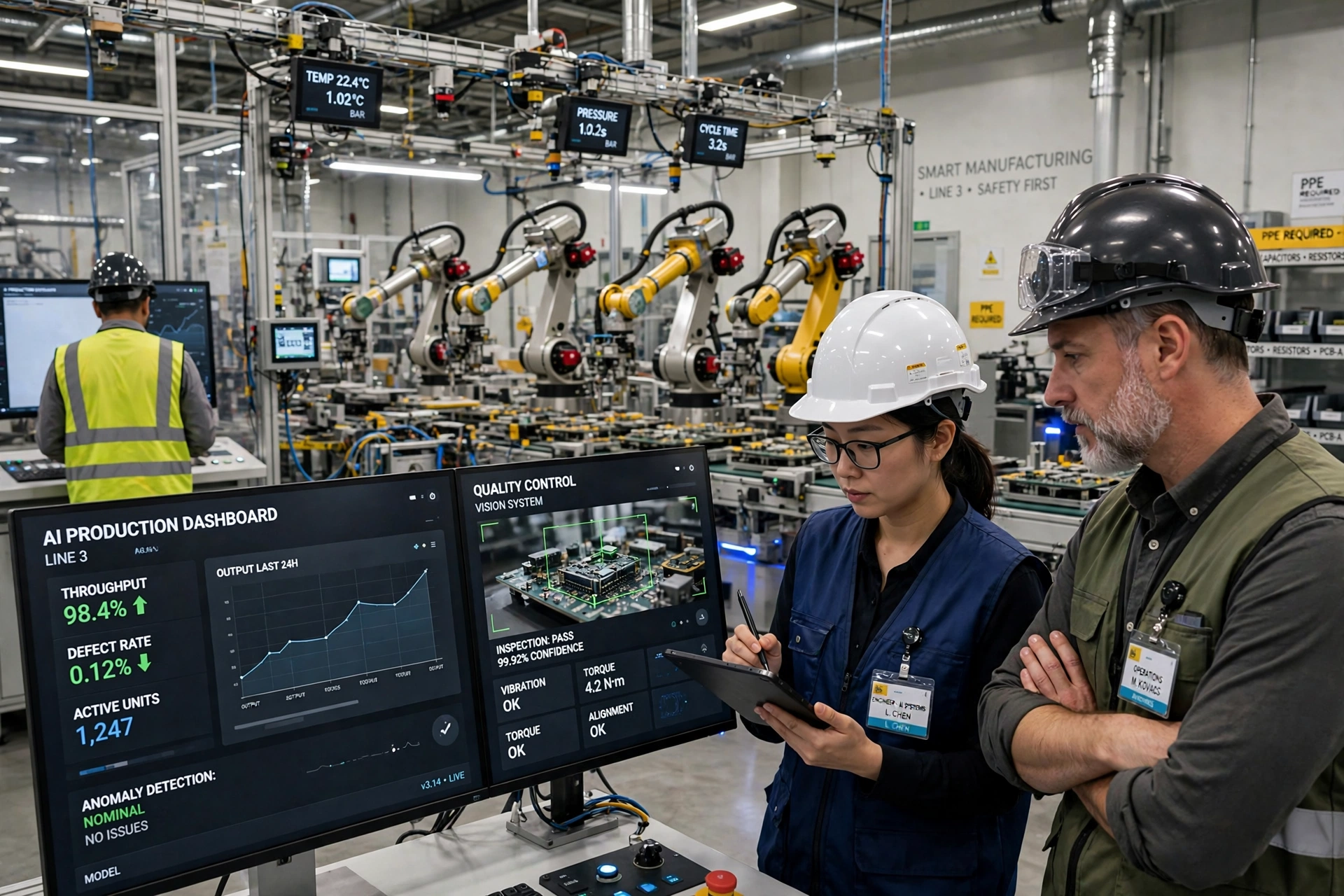
The new generation of factory AI does far more than automate a single repetitive task. Connected sensors now stream data from motors, presses, ovens, and assembly stations, while AI systems learn the normal rhythm of each machine and flag the small deviations that often precede a breakdown. Maintenance teams can be alerted while a part is still working, rather than after a failure has halted production and idled an entire shift.
Quality control is changing just as quickly. Camera systems paired with AI review products as they move down the line, spotting surface flaws, misalignments, and missing components at a speed and consistency that is difficult to match with spot checks alone. When a defect pattern appears, the system can trace it back to a specific station, batch, or setting, helping engineers fix the cause instead of simply sorting out bad units at the end.
Production planning is also becoming more responsive. Instead of locking a schedule for weeks, planners are using AI tools that weigh live orders, material availability, machine condition, and energy costs, then propose updated schedules when conditions change. The result is a factory that behaves less like a fixed assembly line and more like a system that continually rebalances itself around real demand.
Why the Shift Is Happening
Several forces are converging at once. Manufacturers continue to face difficulty hiring and retaining skilled production and maintenance staff, which makes every experienced worker’s time more valuable. At the same time, customers expect shorter lead times and more customized products, which puts pressure on plants built for long, uniform runs. A line that can switch products with less downtime and less waste has a clear advantage.
Costs are pushing in the same direction. Unplanned downtime, scrap, and rework quietly consume margins, and energy has become a larger and less predictable expense. The technology itself has also matured: sensors are cheaper, industrial data is easier to collect, and modern AI tools can be layered onto existing equipment instead of requiring a completely new plant. That lower barrier matters, because it allows mid-sized manufacturers — not just the largest global firms — to start with one line or one process and expand from there.
What It Means
For workers, the shift does not point to empty factories. It points to different work. Routine monitoring and repetitive inspection are increasingly handled by systems, while human roles move toward exception handling, process improvement, maintenance judgment, and working alongside automated equipment. Plants seeing the strongest results tend to involve operators early, train them on the new tools, and treat their floor knowledge as essential input rather than something the software replaces.
For business leaders, smart automation changes how competitiveness is measured. Output still matters, but so do flexibility, first-pass quality, and the ability to prove how a product was made. There are real concerns to manage as well. Factories must protect operational data, keep systems secure, and avoid becoming dependent on tools their own teams do not understand. A prediction is only useful if someone on site can question it, verify it, and act on it sensibly.
The Outlook
The direction for the rest of 2026 looks set. Expect AI to spread from individual machines into fuller plant coordination — linking production, maintenance, quality, and supply decisions in one view — and expect smaller factories to adopt packaged tools that once required custom engineering. The manufacturers leading this shift are not the ones automating for its own sake; they are the ones using AI to answer practical questions: how do we stop less, waste less, and respond faster when orders change? In 2026, smart automation is no longer a future concept for the factory floor. Increasingly, it is simply how competitive plants run.