








Farming has always been a game of decisions made under uncertainty: when to plant, where to water, how much fertilizer a field really needs. In 2026, growers across the United States are making those decisions with a new partner — artificial intelligence that can read a field the way a seasoned farmer reads the sky. The result is a broad shift toward precision agriculture, where treatment is applied plant by plant and acre by acre, instead of uniformly across an entire farm.
What’s Changing
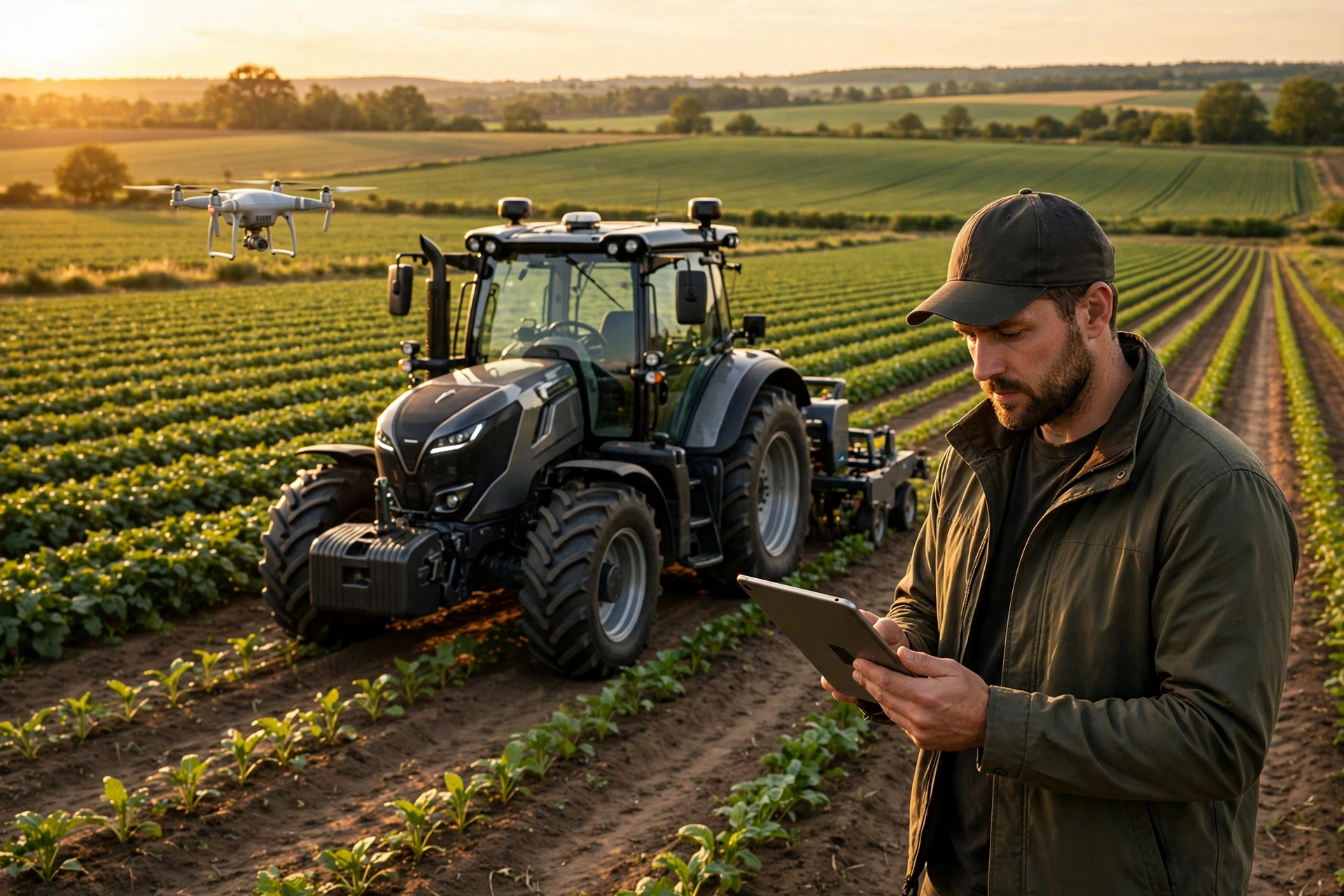
The visible symbols of the trend are drones and smart machinery, but the real change is in the decision-making underneath them. Drones and satellites now scan fields regularly, and AI systems analyze the imagery to spot stress, pests, disease, and nutrient problems days before they would be obvious from the ground. Tractors and sprayers equipped with cameras can distinguish a crop plant from a weed in real time, applying herbicide only where a weed actually stands rather than across the whole field.
Water management is changing just as quickly. Soil sensors and weather data feed AI models that schedule irrigation by section of field, delivering water where roots need it and holding back where the soil is still moist. Planting decisions are getting the same treatment: systems weigh soil conditions, forecast patterns, and seed varieties to recommend not just when to plant, but which hybrid belongs in which part of the farm.
On the business side, growers are using AI assistants to make sense of the flood of data modern equipment produces. Instead of raw maps and dashboards, farmers increasingly get plain-language recommendations — where to scout first, what to treat, and what can safely wait.
Why the Shift Is Happening
The economics of farming leave little room for waste. Fertilizer, seed, fuel, and chemicals are major costs, and applying them uniformly means over-treating much of the field to protect a small part of it. Precision tools attack that waste directly: inputs go where they will do the most good, and nowhere else. In a business with thin margins, that efficiency is often the difference between a profitable season and a difficult one.
Labor is another driver. Farm workers are hard to find in many regions, and experienced hands are aging. Automation — from camera-guided sprayers to robotic weeders — lets smaller crews cover more acres without lowering the standard of care. Environmental pressure matters as well: reducing fertilizer runoff and chemical use is both a regulatory concern and a growing expectation from the food companies that buy what farms produce. Finally, the technology has become practical. Equipment that once belonged to research farms is now sold through ordinary dealer networks, and subscription software has lowered the upfront cost of trying it.
What It Means
For growers, precision agriculture changes the daily rhythm of the job. Time once spent driving every field to check conditions can be focused where the data says attention is needed. Decisions become more defensible and more consistent, and younger farmers entering the business often adopt the tools faster than the generations before them, treating data as another input alongside seed and fuel.
There are honest challenges. Rural internet connectivity still limits what some farms can run, and growers are asking harder questions about who owns the data their equipment collects and how it is used. The tools also require new skills — a farmer today may need to be part agronomist, part mechanic, and part data manager. Equipment makers and cooperatives are responding with training and support, recognizing that the best technology fails if the person running it does not trust it.
The Outlook
Through the rest of 2026, precision tools are expected to keep moving down-market, reaching mid-sized and smaller family farms that once assumed the technology was only for the largest operations. Autonomous equipment will handle more routine fieldwork, and AI recommendations will keep getting more specific — from field-level to plant-level decisions. The direction is clear: farming is becoming less about treating every acre the same and more about knowing each acre well. In 2026, the most advanced tool on the farm is not the biggest tractor. It is the grower’s ability to see the field clearly — and act on exactly what it shows.